
A grooming routine, at its most functional, is a sequence of decisions already made. It runs on the same infrastructure as any other daily protocol: a fixed order, a finite set of products, and a consistent time allocation. The men who spend the least mental energy on personal presentation are, counterintuitively, those who have invested the most thought in building a routine that requires none on a daily basis.
The Case for a Set Protocol
Men's grooming, as a commercial category, has expanded considerably over the past decade. The proliferation of products — cleansers, toners, serums, moisturisers, exfoliants, beard oils, scalp preparations, and their many subcategories — has created an environment in which the act of building a routine is itself a friction-generating exercise. Men who have not previously engaged with this product landscape tend to either avoid it entirely or to accumulate products without a corresponding framework for using them.
The Talenik Letters position on this is straightforward: the goal is a protocol that can be executed in eight to twelve minutes each morning without reference to any external guide. That duration covers skincare, hair preparation, and shaving or beard maintenance at a level of quality that is appropriate to professional and social contexts. It does not require a luxury product budget or specialist knowledge. It requires a sequential logic and a habit of consistent execution.
What follows is not a product endorsement. It is a structural account of how a functional morning grooming sequence is built and maintained. The specific products within each category will vary by individual skin type, local availability, and budget. The category order and the reasoning behind it apply broadly.
The Sequence and Its Logic
A morning skin routine operates on the principle of thin-to-thick application, with active ingredients applied before barriers. The practical sequence runs as follows: facial wash, toner or essence if used, vitamin C serum if the routine includes one, moisturiser, and SPF. In the context of Kuala Lumpur — where UV index readings above 8 are standard for most of the year — SPF is not optional. It is the one product category in which the evidence base for daily use is unambiguous across skin tones and types.
The facial wash step requires more thought than men typically give it. The most commonly used product in male grooming — bar soap — is effective as a cleanser but is chemically alkaline in a way that disrupts the skin's acid mantle, which maintains the surface environment that keeps it resilient and balanced. A dedicated facial cleanser formulated to a neutral pH is a small adjustment that produces a measurably different outcome over months of consistent use.
Hair preparation varies more significantly by hair type and style preference than skincare does. The structural observations that hold broadly are these: products applied to damp hair distribute more evenly and require less volume than the same product applied to dry hair; a quality product in smaller quantity applied correctly outperforms a budget product in excess quantity; and the tool used to apply and shape — whether a wide-tooth comb, a brush, or hands — matters as much as the product itself.
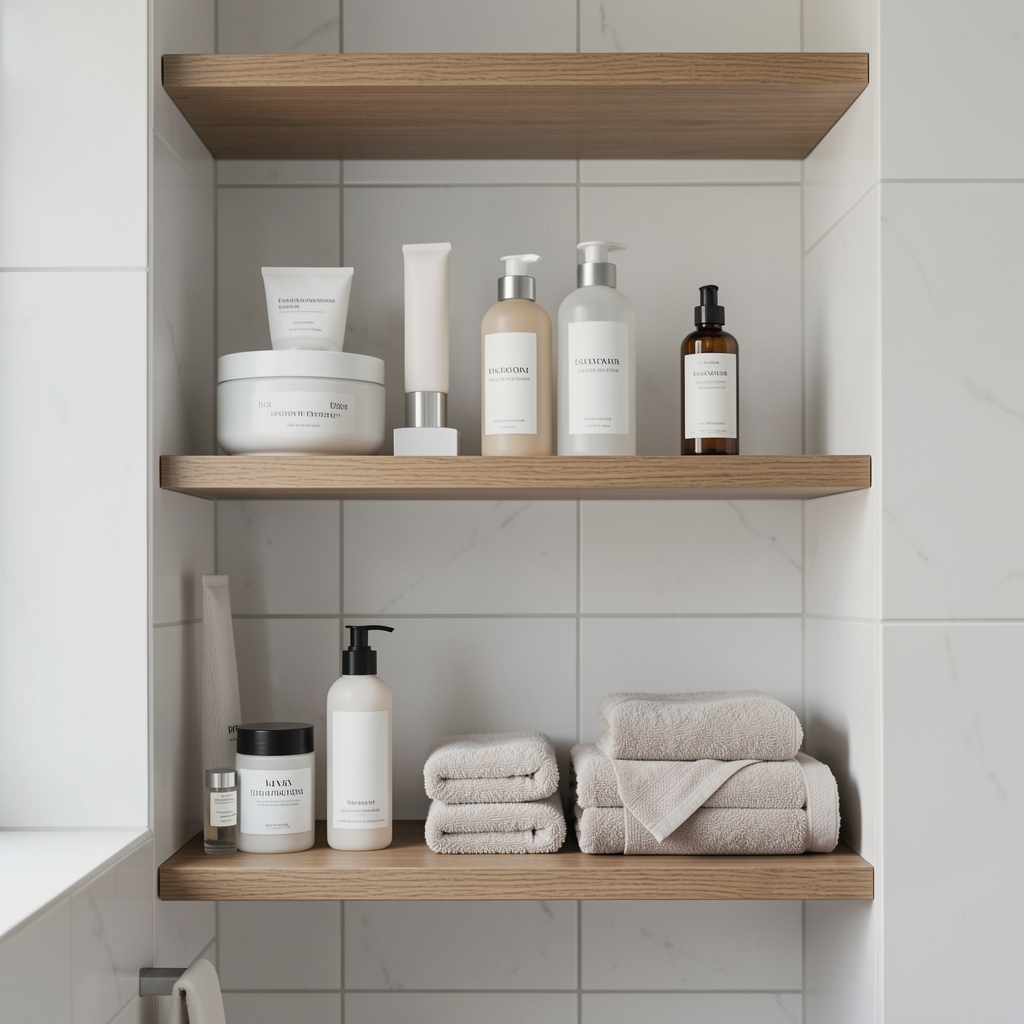
A well-edited grooming shelf. Product count kept to eight or fewer across all categories. Kuala Lumpur, 2026.
Shaving and Beard Maintenance
Shaving is the grooming practice with the highest variance in execution quality among men who describe their routines as functional. The most frequent source of reported irritation — razor burn, persistent folliculitis, and ingrown hairs — is not product quality but technique deficit: shaving against the grain on areas of high hair density, insufficient preparation of the skin surface, and insufficient blade maintenance.
The preparation step is where most time savings are incorrectly made. A thirty-second warm water rinse followed by the immediate application of shaving product is insufficient. Two minutes of pre-shave preparation — warm water held against the face for ninety seconds, followed by a well-formulated shaving product left on the skin for another thirty to sixty seconds before blade contact — produces a materially different result in terms of both shave quality and post-shave skin condition.
For men maintaining facial hair rather than shaving clean, the equivalent investment goes into edge definition and beard conditioning. A weekly trim using a fixed guard length eliminates the gradual loss of shape that accumulates day by day without any single dramatic event. A lightweight beard oil or balm applied daily to clean, slightly damp beard hair addresses the dryness that causes coarseness and flaking in the skin beneath.
In the equatorial humidity of Kuala Lumpur, beard products can be used more sparingly than in drier climates. The ambient moisture level means that the sealing and conditioning function of these products is partially provided by the environment itself. Men who relocate from drier climates frequently over-apply product in the first weeks and need to reduce volume once acclimatised.
"The goal is a protocol that can be executed in eight to twelve minutes without reference to any external guide. Decisions already made. Sequence already set."
— Jasper Carrington, Talenik Letters, April 2026
The Seasonal and Climate Dimension
Malaysia's climate presents grooming conditions that differ substantially from the four-season frameworks in which much grooming content originates. There is no dry winter to manage. The skin does not experience the same seasonal dehydration that drives heavier moisturiser and occlusive product use in temperate climates. The primary adaptive challenge is persistent humidity and heat, which affect sebum production rates and the way product sits on and is absorbed by the skin.
Men in KL who have carried over product regimens designed for drier climates often report persistent congestion and surface breakouts as a result of over-moisturising. The adjustment is typically toward lighter product textures — gel moisturisers rather than cream-based ones, water-based SPF formulas rather than chemical sunscreen in a heavier base — and a reduced total product load.
The wardrobe dimension connects here in a way that is worth noting. In a year-round warm and humid climate, the fabrics in regular rotation — linen, technical knits, lightweight cotton — interact with grooming decisions in practical terms. Fragrances wear differently in heat and humidity than in cool air; anti-perspirant formulation and application timing matter more than in temperate settings; and clothing choices that manage sweat and ventilation become part of the broader personal presentation protocol rather than peripheral seasonal concerns.
Eight product categories. One for each function.
Neutral pH, gel or foam format for humid conditions.
Gel-based preferred in equatorial humidity. Applied before SPF.
Non-negotiable at KL UV index levels. Water-based formula for comfort.
Applied to pre-wetted skin. Left on for 60 seconds before blade contact.
Fragrance-free preferred. Applied immediately post-shave on clean skin.
Applied damp, in minimal quantity. Format matched to hair type.
Lightweight oil or balm for bearded men. Reduced quantity in humid climates.
Applied to pulse points on dry skin. Lighter concentrations perform better in heat.
On the Narrower Point of Standards
A grooming routine is not a performance of vanity. It is a maintenance protocol applied to a functional surface. Men who maintain their tools — their running shoes, their knives, their vehicles — understand the practical logic of that maintenance without requiring justification. The same logic applies to personal presentation. It is not more complicated than that.
The standard to hold is not magazine-cover perfection. It is the standard of a man who has thought about what he uses, why he uses it, and how it fits into a sequence that runs in the background of his mornings without demanding attention. That is the standard of a considered routine, as opposed to a random accumulation of products used in an inconsistent order.
The payoff is not vanity. It is the thirty seconds of self-assessment at the end of the sequence that produces a consistent result — and then leaves the rest of the morning, and the day, for everything else.